<historical recollections>
Yeah, another non-war we non-won.
Between the TET offensive and the ultimate fall of Saigon, I had started to have severe doubts about the accuracy of our press system and its information sources. Up until then, I didn't give much of a rat's ass about world affairs. I had my own affairs to tend to. I was in college and married and had a 2S draft exemption, so I wasn't too worried about it. (Yes, I still have my original draft card.)
But at about that time I had also obtained a short wave radio and started to listen to foreign news broadcasts, Radio Netherlands, Radio Moscow, the BBC, even Radio Tehran, which were all broadcast in English. What the hell, there wasn't much else on short wave radio except the amateur radio operators, and at that time, I didn't know Morse Code.
The thing was, while all these stations had their own "slants," they pretty much agreed on the reporting of facts, per se. But when I read in the US papers about a specific event that had been reported on foreign radio stations, it was like the event had happened on a different planet.
So as a kind of micro-hobby, I started to research this thing called "journalism." Bear in mind that this was before the internet, and it involved digging actual paper books and actual paper articles out of the library and actually reading them, page by page.
Of course I also found out about that thing called "yellow journalism" and the Hearst news-selling machine and his remark about what a "pretty little war" the Spanish-American War had been, and which he, practically on his own, had started.
"Remember the Maine," had been a catchphrase for decades, and I discovered that there was high suspicion that the sinking was from an accidental explosion, which was blamed on the Spanish. Mostly, by Hearst, it was alleged.
So I started to distrust our news machines, especially newspapers. About that time Walter Cronkite had been referred to as the most trusted man in America, which was mentioned in the OP's video, if you haven't actually watched it.
But the main thing to me was the juxtaposition: If there was "a most trusted man," the implication was that there were others who were not to be trusted.
Hmmmmm, said I to myself.
It was about then that I also discovered one of the most powerful information tools that the President had, besides intentional leaks of information, was his control over who had White House Press Credentials. It was alleged several times in some of those obscure articles that if the President didn't like what you (or your publisher) said, it was statistically likely that your (and your publisher's) White House Press Credentials would be revoked.
Well, true or not, it seemed to me that this was a viable tool (or threat, however subtle) to be used in manipulating what came out of the press conferences... bearing in mind that they were not necessarily broadcast on live commercial TV at that time.
Then, later, there was the ultimate Fall of Saigon.
As the Wiki article on the Fall of Saigon put it:
The rapidity with which the South Vietnamese position collapsed in 1975 was surprising to most American and South Vietnamese observers, and probably to the North Vietnamese and their allies as well. For instance, a memo prepared by the CIA and U.S. Army Intelligence and published on March 5 indicated that the South Vietnam could hold through the current dry season—i.e., at least until 1976.[5]
"Suprising," my soft pink ass! That really blew my mind. And all this time we were so impressed with those body count numbers. Yay! A hundred VC or NVA killed for the "loss" of only ten Marines. Yay! Oh, look, we're bombing the hell out of their supply trails! Yay!
Gee, it reminded me of the Korean Not-War. (For which I had been too young to be drafted.)
So I learned to distrust information in the press altogether.
And this distrust started between the TET offensive and the fall of Saigon.
I thank those who served, and especially the 50,000+ killed in the Viet Nam operation, but it sure opened my eyes.
</historical recollections>
Terry, 230RN
The evacuation of Saigon:
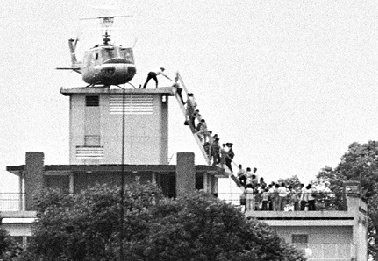
Note this is from the Wiki article at
http://en.wikipedia.org/wiki/Fall_of_SaigonWikipedia maintains that this is an iconic historical photograph and falls under the fair use doctrine on that account. I shall rely on that.
MORE:
http://images.info.com/fall%20of%20saiagon?qcat=images&qkw=fall+of+saiagon(Edited for minor corrections)