i still don't quite understand the OCW procedure. can someone please explain the process to me so i can work up some decent plinking loads? i read the science and it seems to make sense. i'm just not too keen on the procedure.
Bullet: Hornady 55 gr SP and Hornady 55 gr FMJBT w/ cannelure
Powder: IMR 8208 XBR
Primer: CCI SRP
Case: Lake City
OCW by Dan Newberry -
http://optimalchargeweight.embarqspace.com/This is the method I use exclusively to work up loads for rifle. It uses less powder and components, and it is tailored to 100 yard shooting. (can do 50 yards too for iron sights or reddots)
Basically what I do is, do a lot of research online for those that have used that powder/bullet combo, then I cross reference that to manufacturer data to make sure the load is within safe limits.
Load up a safe load in .3 to .5 grain increments. I'd do .3 in a .223/5.56 because the case is so small. load up a series of at least 5, three round sets(5 rounds if you think you might call pulled shots), in the range of the chosen load window, and load up 2 or three extra of the lowest to make sure you are impacting near the aim point.
Say if people are having success with 24.3 grain load 24, 24.3, 24.5, 24.8, and 25.1 (this is just an example I don't know what people load for these components)
shoot a few lower charges at a sighter mark, so that you are impacting near that mark. It is not important you are dead on that mark, but you don't want to be impacting so far away from it that it interferes with the other target marks.
Then go out to the range and shoot round robin at the targets you set up at 100 yards. So shoot one of the 24 at one aim point, one 24.3 at another aim point, one at 24.6 at another aim point, and so on. Then go from high charge back down to low charge shooting the corresponding aim point of that charge weight. Always check the primers and cases for signs of overpressure. If there is overpressure don't shoot that and anything above that.
If you are using a higher power scope at 100 yards I like to use the smallest aim point as possible while still being able to see it and aim precisely. If I am shooting irons or red dot I use the smallest black that I can see with my eye at 50 yards. (aim small miss small)
Make every shot a good shot, take your time, set up natural point of aim, break the shot clean each time. If you call a pulled shot, take note of impact and discount it. Fliers may appear, don't discount those, only discount shots you know you pulled.
Most important is you are not looking for the tightest group at this point. You are only looking for a range of charge weights that impact in the same area relative to the aim point. DON'T be tempted by a super tight group but fliers below and above that charge. That is not the charge you are looking for. You want an OPTIMIUM charge weight that will shoot good even if you are a little low or a little above what you settle on.
I'd start your load development at the bottom of the cannelure. When you set up your seater on one bullet at the very bottom of the cannelure leave it alone after that. sometimes they are not in exactly the same spot, and that isn't really important, don't try to chase it around at this point. Just set it up there and leave all the round to be seated that way.
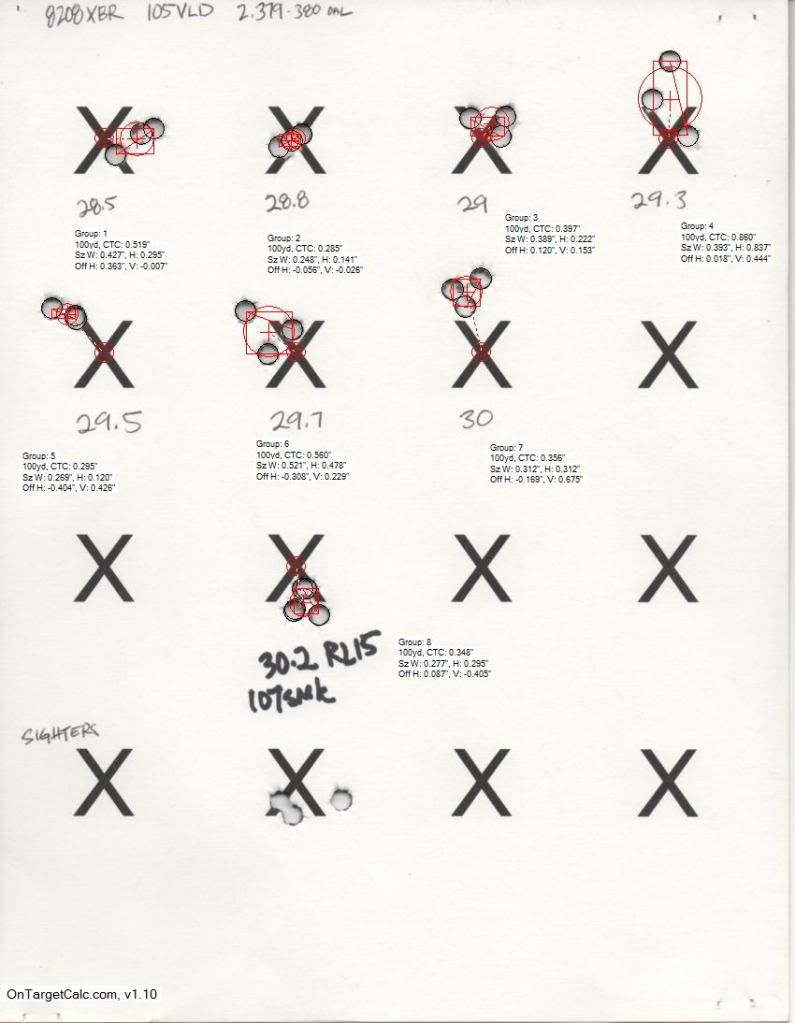
Here is a good example. Notice the 44 grains is the tightest group, but I'd pick the 44.2 as OCW for this set because the groups below and above it are impacting in pretty much the same area. That being said if I shot all three charge weights at the same aimpoint the resulting group would still be sub MOA.

When you find a range of 3 loads that group in essentially the same spot in relation to the aim point, you pick the center charge as your OCW. You them load up sets of that charge weight and seat the bullet deeper in .005" increment to bring the group in tighter. Shoot 3 shot groups round robin like you did before, You will see the groups shrink them grow back out. The smallest group is the target load.
Here is a good example of how the charge weights progress. I've seen this many times with all different rifles and calibers. It always looks similar. Some rifles may not have as tight groups, but the results are always similar to this.
Notice how three charge weights group in a given area, then they get blown out, then the next set moves point of impact and back into somewhat that same pattern. That blow out is called the scatter node. This is the point where the bullet is leaving the barrel when it is moving around the most from the recoil, shockwave, and explosion of powder. You don't want a load in that area of charge. it will be the least accurate.
Here is an example of how seating depth changes the groups. These are going deeper into the case by .010"

When you find that good load and don't have to worry about making the charge exactly at the right .1grain, you just sight in your scope and blow out the X ring.....
